Responsible AI research
Study how recommendation, personalization and generative AI shape choices, trust and information environments.
Explore research →I lead research and innovation at the intersection of recommender systems, computational user behaviour and trustworthy AI — turning rigorous evidence into technologies, organisations and real societal impact.

Full Professor at the University of Bergen and Founder & Director of SFI MediaFutures
What I do
My work connects rigorous behavioural research with responsible technology design, institutional leadership and practical implementation.
Study how recommendation, personalization and generative AI shape choices, trust and information environments.
Explore research →Build interdisciplinary teams, partnerships and long-term programmes that move ideas from evidence to field deployment.
See selected impact →Help leaders, product teams and public organisations turn complex AI questions into clear strategy and responsible decisions.
View services →Selected impact
As founder and director of SFI MediaFutures, I conceived and built a national research–industry ecosystem for responsible media technology. The centre’s outputs are collective achievements. My contribution combines direct research and scientific leadership with the vision, consortium-building, funding, agenda-setting and organisational infrastructure that enable researchers and partners to translate work into tools, pilots and practice.
Partner outcomes
Selected examples documented across the MediaFutures annual reports, from verification tools adopted internationally to recommendation and editorial systems tested with partner data and users.

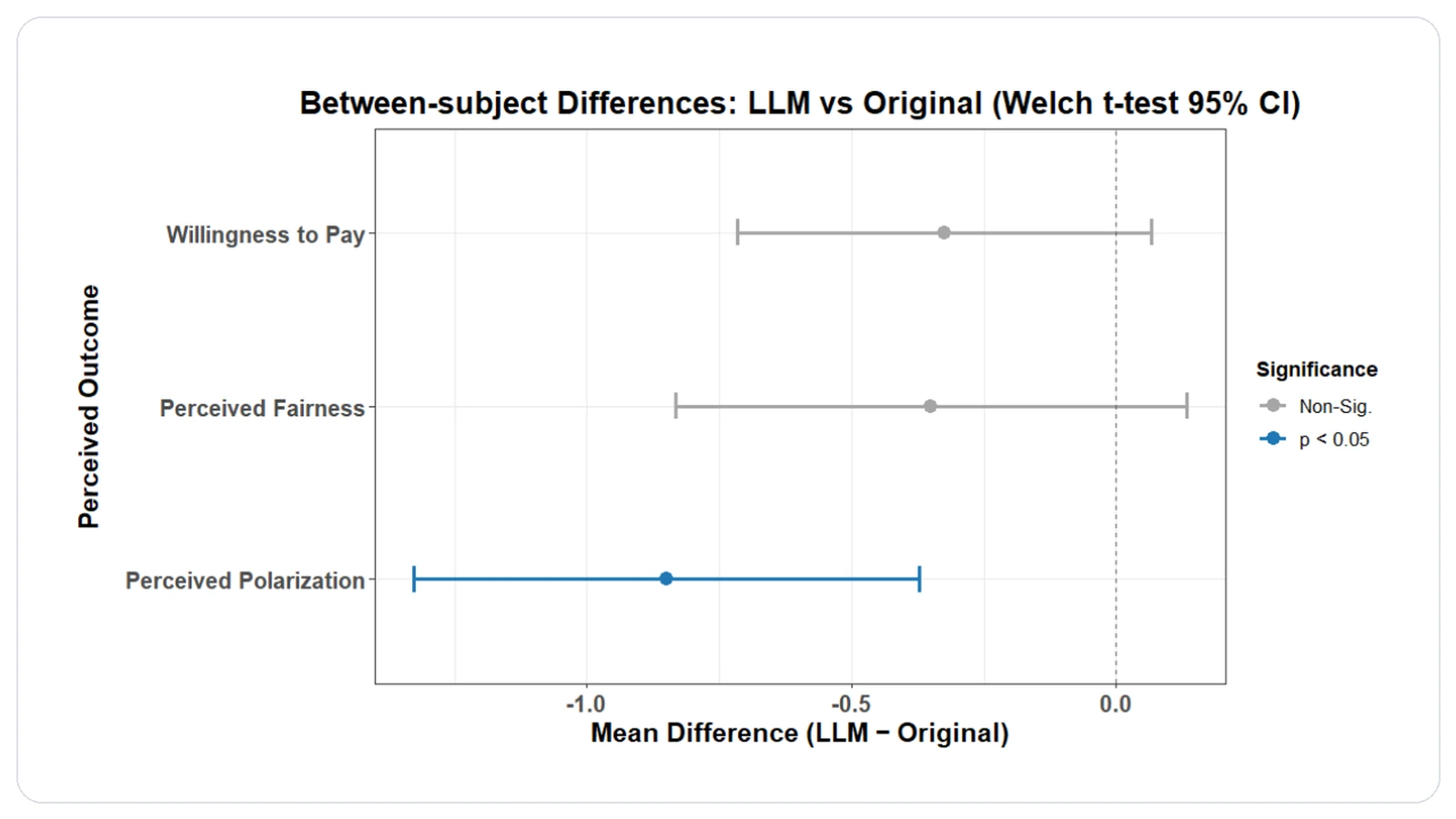
A three-country study translated content credentials into evidence for newsroom and platform design.

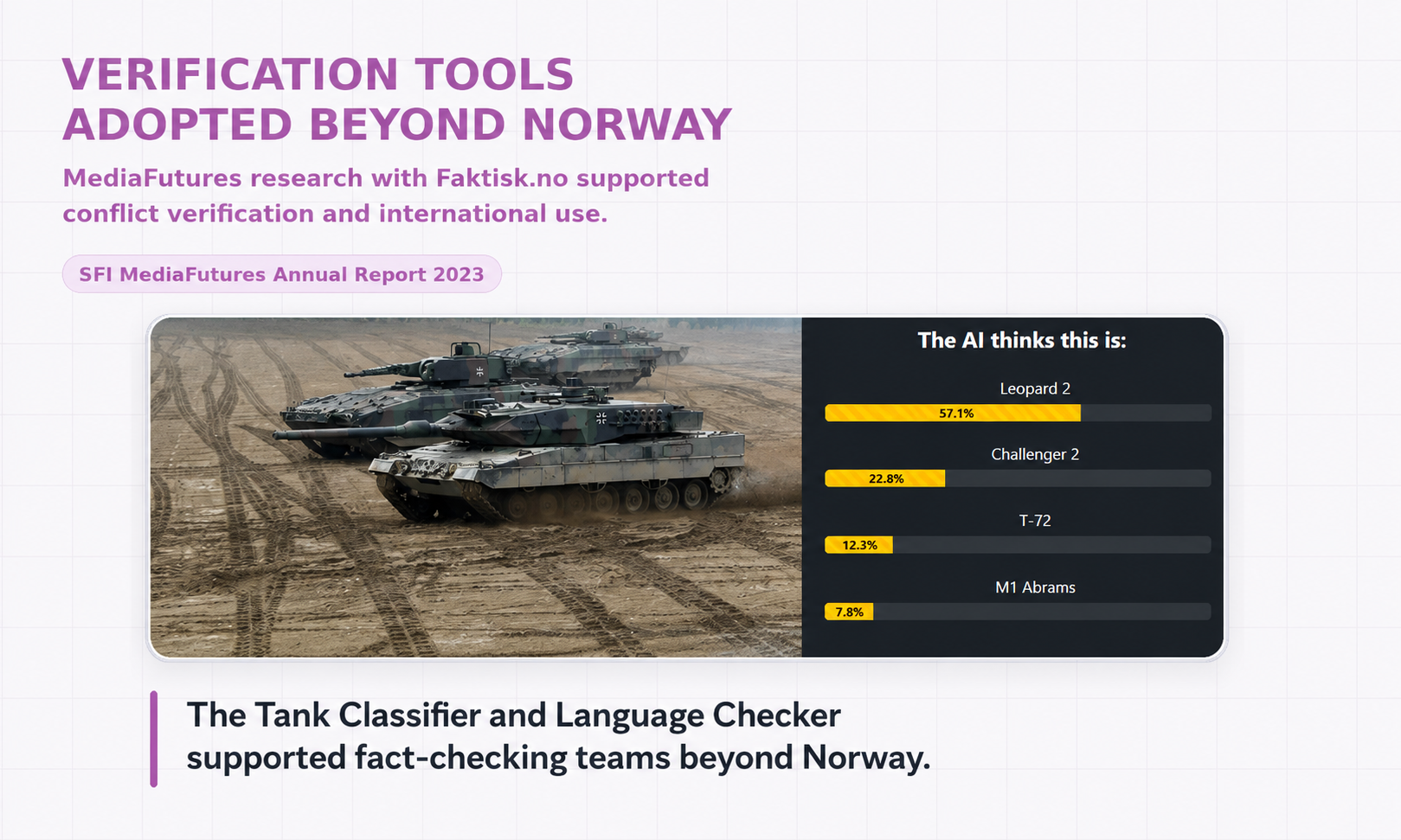
Tools developed for conflict verification were used by fact-checkers and adopted by teams beyond Norway.

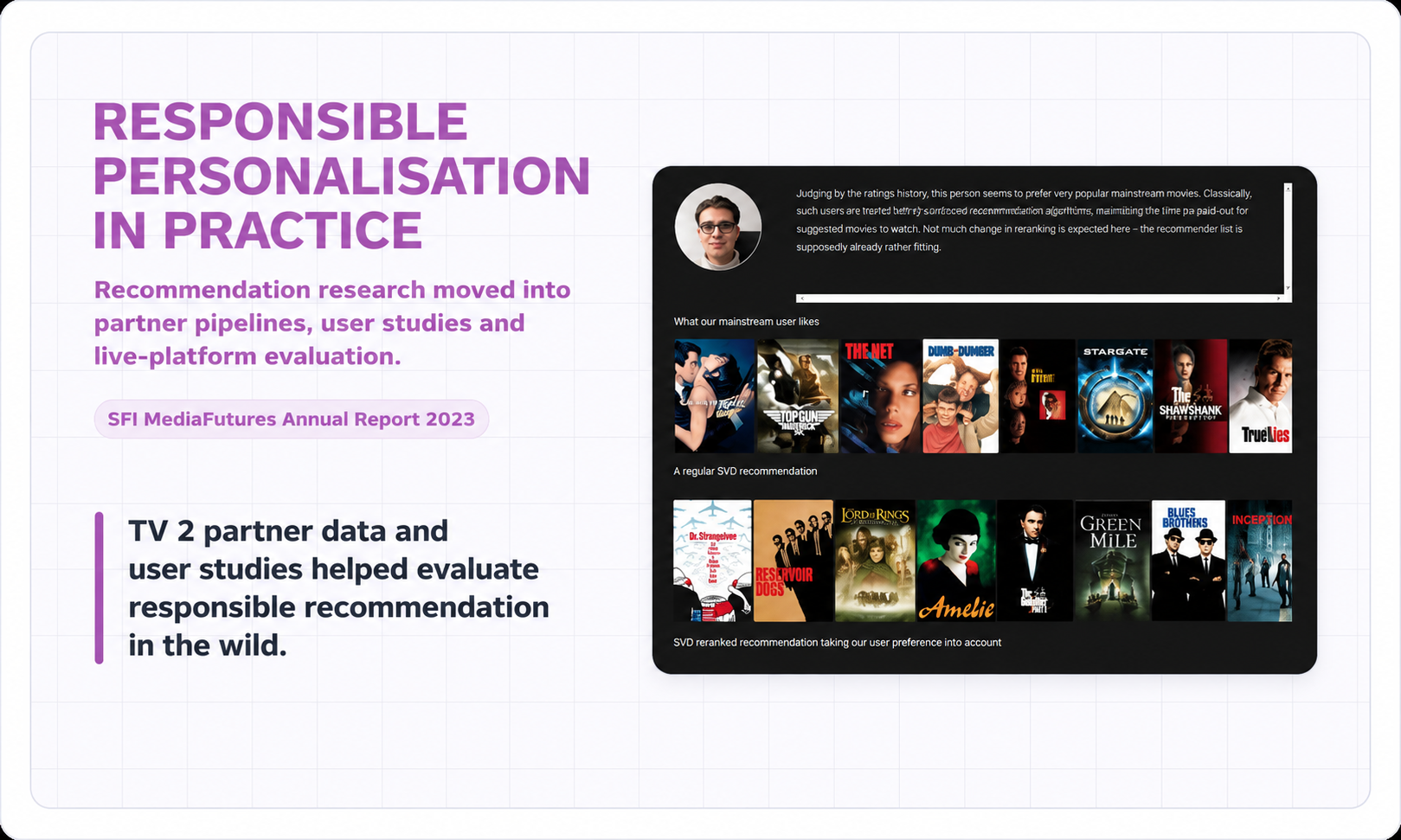
Responsible personalisation moved from models and prototypes into partner pipelines and live-platform evaluation.
Profile
Christoph Trattner is a professor and research leader working on responsible recommender systems, computational user behaviour and trustworthy AI. With more than 20 years of experience at the intersection of academia, industry, and applied AI innovation, he helps organisations design, evaluate, and govern AI systems that influence human decision-making in high-impact domains such as media, health, food, and consumer behaviour.
He is a Full Professor at the University of Bergen, Director of the Research Centre for Responsible Media Technology & Innovation (SFI MediaFutures), and founder and leader of the DARS research group, Norway’s largest research group on recommender systems. He also leads the Norwegian Computational Behaviour & AI Lab, where interdisciplinary teams develop responsible AI solutions for real-world societal and business challenges. In addition, he is a founding member and board member of NoSoCSS, an interdisciplinary initiative advancing computational social science in Norway and beyond.
Trattner has initiated and led large-scale research and innovation collaborations involving startups, public-sector organisations, and multinational companies across Europe and the United States. As founder and director of SFI MediaFutures, he conceived and built a national research–industry ecosystem that translates responsible AI research into practical technologies for journalism, media production, recommendation, fact-checking, accessibility, and democratic resilience.
Work with me on a keynote, advisory engagement or research collaboration →
Selected leadership & service
A few concrete examples of how I have contributed to research communities, institutions and professional evaluation.
Served on the board of Media City AS through June 2022, contributing to Bergen’s media and technology ecosystem.
Workshop and Late-Breaking Results Co-Chair for the ACM Conference on Recommender Systems.
Served on the Senior Programme Committee of a leading international information-retrieval conference.
Selected by ACM to communicate computing research to professional, academic and public audiences.
Recent activity
Happy to share that our SFI MediaFutures paper “Explanations for Recommended Low-Interest News Articles Fail to Persuade Selective News Avoiders” with Svenja Lys Forstner and Alain D. Starke has been accepted at the INRA workshop at ACM UMAP 2026 in Gothenburg.
Great news to share: our paper “Impact of a Prototype Combining Recommender Functionality with Structured Documentation on Operator Performance in Calls to Medical Communication Centers: A Quasi-Experimental Feasibility Study” has been published. The work explores how recommender-based decision support can contribute to medical communication and emergency primary care. Link
Very happy to share that two new Research Council of Norway mobility projects connected to SFI MediaFutures and the University of Bergen have been awarded: CuratedAI, focusing on AI transparency, media literacy and appropriate media trust, and VaccAI, focusing on trustworthy health communication and vaccine beliefs in Norway and Ukraine. Together, the projects represent NOK 17.1 million in funding.
Very happy to share that two of our full papers have been accepted at ACM UMAP 2026: “Increasing Editor Trust in News Personalization Systems with Fact-checked Large Language Models” and “Using AI as a Chef: Users Overlook Nutritional Flaws in LLM-Generated Recipes”. Both papers are led by my research assistants Tobias Jovall Wessel and Yelyzaveta Lysova as first authors, together with Alain D. Starke and myself.
Happy to share that I will be on parental leave until mid-June, spending time with my daughter.
We are happy to announce NoSoCSS — a new interdisciplinary initiative advancing research at the intersection of computational social science, data, and society: https://nosocss.org/.
Scholarship
Three recent studies spanning responsible media AI, user trust and health-related generative AI.

A study of how fact-checked LLM support can shape editor trust in personalised news systems.

Examining how people assess the nutritional quality of recipes produced by large language models.

A cross-country study of how content provenance labels influence trust in digital news platforms.